|
article
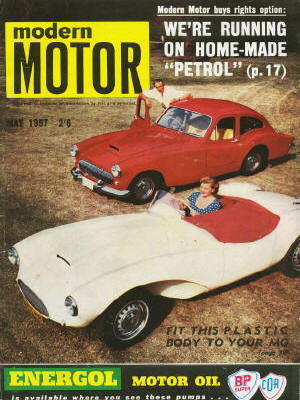
from "Restored Cars" The first Australian fibre-glass car
body project to sell strongly enough to become financially rewarding was
the Buchanan, an after-market sports roadster for fitting to the smaller
sports car chassis such as M.G. T series, Singer, Austin A40 and others
with wheelbases measuring between 7 ft. 3 in. and 8 ft.
It was the promotion of Nat Buchanan, a TV/radio manufacturer and motor
sport competitor who hit on the idea of using the former Kangaroo Stable
Aston-Martin DB3S competition car of Tom Sulman as the buck for his master
moulds.
This was but one thrust of his two-pronged attack on the market as, when
released in 1956, it was to partner an earlier project, a coupe intended
to be sold as a complete car. Mounted on a chassis of boxed side rails
with five tube cross-members, designed by Arthur Rizzo, this coupe had a 7
ft 7 in. wheelbase and a transverse leaf ifs.
The car made use of Enfo mechanicals and was powered by the four-cylinder
Consul motor, tweaked to give 70 bhp., although the Zephyr Six could be
specified at extra cost. As Nat had been campaigning a Zephyr in sporting
events, the motor of which Wal Warnerford had waved his magic wand over to
transform the gentle zephyr into a whirlwind, it was not surprising that
the Enfo products were his choice. The N.H. Buchanan Motor Co., which
shared the premises of Electrosound, in Nelson Street, Annandale, N.S.W.,
also marketed the Warnerford conversions for Consul and Zephyr motors.
The whole coupe body was produced in one piece so the mould had to be
built up from seven sections to allow the completed body to be extracted.
There was no external boot lid, merely a spare wheel access door, so any
luggage had to be reached via the interior. This coupe, with 2 + 2
seating, had a 10 gal. fuel tank, weighed 16 cwt., had a practical 7 in.
of ground clearance but appears not to have been rushed by an eager and
grateful public; only the one having been constructed it is believed.
The roadster body kit for customer fitting, however, did meet with wide
approval as the lighter weight was a great plus for sporting drivers; the
weight of a M.G. T.D., for example, being reduced from 17 1/4 cwt. to 14
1/2 by the fitting of the Buchanan body. In 1957 Nat's own car, the
Buchanan M.G., was claimed to be the lightest and fastest T.D. then
racing, winning at six out of ten starts. Top speed of this car was 103
mph. and its time for the standing start 1 /4 mile was 17.2 seconds.
At £255 the body offered was very basic, having only
doors, bonnet and boot lid fitted but no screen, floor-boards, seats,
instruments, body hardware, electricals or painting; these costing a
further £176. Other stages could be had at increased cost, up to rolling
form mounted on a Rizzo-designed twin-tube ladder frame fitted with M.G.
coil independent front suspension. For outright competition use a very
stark version, having only one door as required by racing regulations and
the very minimum of everything else could also be purchased.
Nat also came up with a hard-top for those, or their
lady friends, seeking extra comfort and also introduced a chassis frame
designed to accept Holden components. A narrowed front suspension subframe
would bolt in and the spring mountings at the rear were sited to suit the
Holden semi elliptics. A package of this frame, body, i.f.s. and a
narrowed rear axle was offered at a cost of £395.
More than one hundred bodies had been sold by 1958 when the Buchanan
moulds were sold to Jennens & Simmonds of Parramatta Road, Croydon. who
went on to produce about fifty further units. The bodies built by Buchanan
are distinguished from those produced by J. & S. in having a numbered body
plate attached.
article
from "Sports Cars & Specials" If at first you don't succeed,
try and try again. That may well have been Nat Buchanan's maxim for he
certainly tried hard again and again to establish a successful Australian
sports car. The attempts didn't make him a fortune but he did make quite a
few cars, and in so doing made Buchanan one of the best known names in the
local specialist sports car industry. It was for good reason that this
happened; three good reasons, actually.
The first Buchanan made news in the mid-50s with the announcement of a
prototype sports car. The Buchanan was an attractively styled coupe with
lines right up to date with the latest European fashions. The body was
fibreglass and sat on a special chassis using the engine, gearbox and
other mechanical parts from the Ford Consul and Zephyr sedans.
The prototype created great interest and generated the inevitable claims,
rumors and speculation about production-soon-to-follow. But that was as
far as it got. The prototype Buchanan coupe was the only one ever
completed. However that lone example was known to still be running and in
good condition more than 20 years later.
Though Nat Buchanan still dreamed of making his own car, his ambitions
changed somewhat when the Ford-powered coupe project failed to get off the
ground, for it wasn't long after this he decided the time and market were
ripe for a "conversion" sports body.
And so was born the Buchanan body, or as it became known among enthusiasts
- the Buchanan Body. In what proved to be a very shrewd and successful
move, Buchanan hatched an agreement with Tom Sulman. He borrowed Sulman's
Aston Martin DB3S sports-racer and, after subtly changing some details of
the body styling to save too much embarrassment, used the shell as the
mock-up on which the fibreglass moulds were made.
The immediate success of the Buchanan Body proved the Aston Martin DB3S
might have been made for the job. It was a good looking shape in its own
right, with long racy lines that stamped it as a serious sports car. And
it didn't hurt that Aston Martin's racing reputation was riding high at
that time. There couldn't have been many cars better than the DB3S for a
specialist body to resemble.
Before long Buchanan was selling the bodies as fast as he could make them.
The handsome shell became most popular for converting TD and TF model MGs.
Literally dozens of MGs had their traditional square-rigger bodywork
removed. Then, in a matter of some hours' relatively easy work in adapting
the new `glassware', the owner was the proud passenger of a car that not
only looked better than the original (in his eyes anyway) but went better
too, thanks to the reduced wind resistance and weight.
Aside from the favoured MGs, the Buchanan Body also went onto many other
cars including Triumph TRs and a variety of homebrewed specials, usually
Holden powered. Some were made for racing but by far the most went on to
the street. Buchanan also offered a special chassis that took Holden
running gear, and later offered a neat hardtop for the body.
Altogether production topped the 100 mark before the firm of J & S
Fibreglass acquired the moulds from Buchanan in 1959. In the following
years J & S added a further 45 or so to the tally, confirming the
Buchanan's place as one of Australia's most popular conversion bodies.
The reason Nat Buchanan didn't continue with the body was that he had his
hands full with a difficult and demanding new project; his third (and as
time was to tell, his last). There had been rumours, of course, that
Buchanan was up to something, yet it still came as a pleasant surprise for
enthusiasts when in 1958 first details of the Buchanan Cobra were
released.
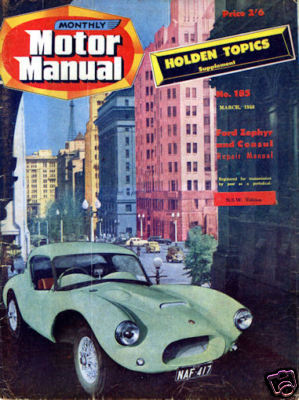
Intended to be a relatively cheap sportster, the Cobra was designed to
borrow as many mass-produced mechanical parts as possible and to be
manufactured as a complete car.
The mechanicals were mostly of Standard 10 origin, including the engine,
gearbox (with remote gearshift lever from the Standard Pennant model),
leaf-sprung rear axle and the wishbones and coils independent front
suspension. Not to forget the seats, steering wheel and other miscellanea.
The running gear was carried on a robust ladder-type chassis using
box-section main members. Manufactured for Buchanan by Pressed Metal Corp
(later involved with the Austin Healey Sprite) the chassis also supported
the fibreglass body, which was a thoroughly professional job from nose to
tail. The nicely styled shell was more than just a pretty face for it was
functional too, and very well finished both outside and within the
cockpit. Weather protection, for instance, wasn't an afterthought for the
equipment included a proper windscreen, side curtains and a practical
soft-top.
The interior boasted a fully carpeted floor and a big boot with access
from the cockpit as well as the rear lid. The dash panel was thought by
some reporters to be a bit plain for there was no tachometer, but the huge
unlidded "glove" compartment on the left was welcomed.
|